
Kashmir: A Land of Makers


There is a particular kind of patience that lives in the hands of someone who carves walnut wood. Not the patience of waiting but of knowing, knowing that the grain will resist in certain places that the chisel must be angled just so that the chinar leaf emerging from the dark surface was already there, long before the tool touched it. You watch a Kashmiri craftsman at work and you sense that the making is not entirely his invention. It belongs somehow to a longer conversation.
Kashmir has always been a place where things are made. Not made casually, not made quickly, but made with a kind of deep and almost stubborn intention and the more you look into where this comes from the more you realise it is not simply a matter of tradition. It is something built into the very geography, history and spirit of the valley itself.
Before we speak of craft, we must speak of place. Kashmir's position in the world is extraordinary. For centuries it sat at the meeting point of the Silk Road's most vital routes the passage that connected Persia to Central Asia to China, the mountain road through the Karakorams that traders navigated with wool and dye and knowledge. UNESCO's research on the Silk Roads has described how Kashmir served as a crucial trading hub where merchants, artisans, pilgrims and adventurers exchanged not just goods but techniques, aesthetic ideas and ways of seeing. Into the valley came wool from the Central Asian steppes, felts from Kirghiz nomads, kirmiz dyes from Armenia materials that found their way into the hands of local craftspeople and became something entirely new.
This is important point to hold in mind that Kashmir was never culturally isolated. It absorbed Buddhist philosophy, Hindu cosmology, Persian aesthetics, Mughal refinement, Sufi sensibility and rather than being flattened by these influences it made something singular out of all of them. Valleys artistic identity developed through centuries of cultural convergence, moving from ancient rock carvings and Thangka paintings to the vibrant Nakashi traditions, each layer adding to rather than erasing what came before.
Dr. Pratapaditya Pal who spent over three decades researching Kashmiri art in its entirety from 2nd century stone sculpture to 20th century embroidery, found in it a coherence that went beyond style. It was a coherence of spirit, of people who across faiths and centuries and conquests, kept choosing to make beautiful things.
The moment when Kashmir's craft tradition truly crystallised into something recognisable has a name: Sultan Zain-ul-Abidin known in Kahsmir simply as Bud Shah (the Great King), his reign reads almost like a deliberate act of cultural imagination. He invited craftsmen from Samarkand, Bukhara and Iran, trained local Kashmiris alongside them, patronised artisans and scholars and in doing so established an entire ecosystem of making.
Papier-mâché/Naqashi, the craft that would later become synonymous with the valleys identity, found its deepest roots in this period. Artisans from Samarkand brought with them the art of kar-i-kalamdan (the craft of decorated pen cases) which Kashmiri makers then absorbed, transformed and eventually made entirely their own. The naqqash who painted these surfaces was not simply decorating an object. The craftsman elaborated with aesthetic precision and imagination what he felt was worthy of being reproduced from his environment. It was an act of looking as much as making.
That idea of looking carefully at ones environment and then finding a way to carry it into material form runs through almost every Kashmiri craft. The iris, the chinar leaf, the bunches of grapes that appear in carved wood and woven carpet alike: these are not borrowed motifs. They are the valley itself, distilled into pattern.
Walk through almost any older neighbourhood in Srinagar and traces of this culture remain. A half-finished papier-mâché box drying beside a window. A carpet loom occupying an entire room. A calligrapher bent over his desk while afternoon light slowly moves across the paper. Even for those who never became artists themselves, making has always felt close at hand.
Perhaps this is also why making feels so natural here. In Kashmir beauty was never confined to galleries or palaces. It appeared in window lattices, embroidered shawls, carved ceilings, copper vessels, gardens designed around changing seasons and in the objects people used every day. Art was not separate from life. It lived alongside it.
The walnut tree takes three hundred years to mature before its wood is considered ready for the finest carving. Three centuries of a tree growing in Kashmiri soil absorbing its winters, its particular quality of light, its silence before a craftsmans chisel first touches it. The resulting wood is hard yet yielding, with a grain and texture that allows for detail rarely achievable in any other material. There is something in this that resists easy explanation. Part of the answer is historical the patronage, the Silk Road, the cross-cultural exchange. But there is another part that has to do with how knowledge moves here. In Kashmir the transmission of craft has traditionally happened not through institutions but through proximity, through watching and through hands. There is an intimate connection between hand and mind, knowing and doing cannot truly be separated and Kashmiri craft traditions have always understood this. The master artisan and the apprentice share a space, share tools, share silence. The knowledge passes through the body before it passes through language.

A Painting By Mohammad Ashraf Munshi 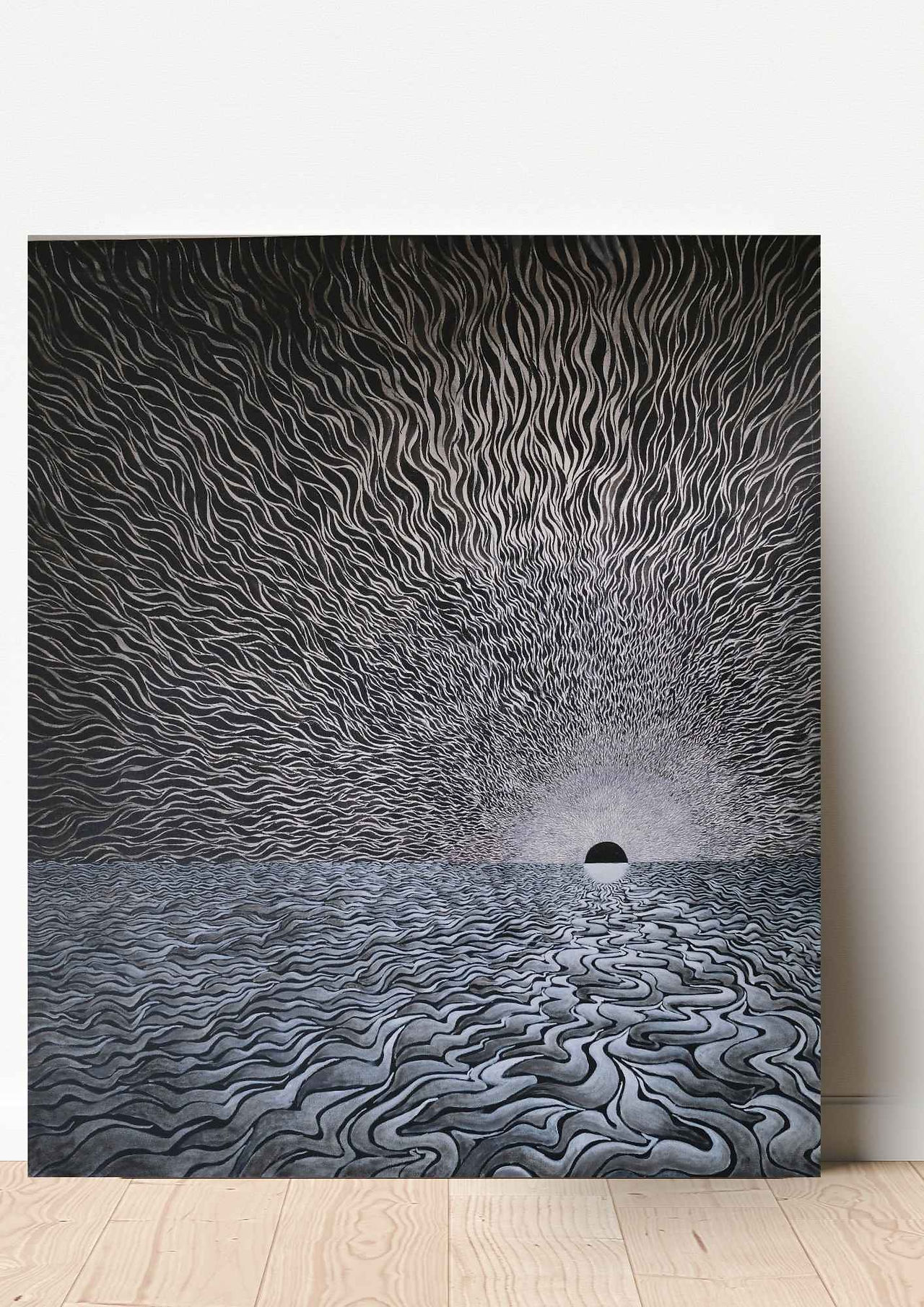
A Painting By Mohammad Ashraf Munshi 
A Painting By Mohammad Ashraf Munshi
Growing up in Kashmir, many of us encountered art before we ever called it art. It was in the carved furniture of grandparents homes, in handwoven rugs, in old family photographs, in the notebooks of schoolchildren who spent more time sketching than listening. Creativity often existed quietly around us, woven into everyday life so naturally that it almost disappeared into the background.
Kashmir's artistic traditions have also survived periods when it would have been easier for them to disappear. Generations have lived through changing times, uncertain futures and moments that tested both communities and individuals. Yet somehow amid all of this people continued to paint, weave, carve, write and create. Those hands never stopped to shape material into meaning.
There is something profoundly moving about that persistence. It reminds us that creativity is not simply born from comfort or stability, sometimes it becomes a way of preserving humanity itself. Contemporary Kashmiri artists continue this conversation in their own ways. Painters work through questions of memory and identity. Sculptors find form in stone and metal. Photographers document places and moments that might otherwise disappear. Their mediums may differ from the craftsmen who came before them, but the impulse remains remarkably similar: to pay attention, to create meaning and to leave something behind.

To make something with care is one of the oldest forms of hope. Every carved panel, woven carpet, painted surface or unfinished sketch begins with the belief that something meaningful can exist where previously there was nothing. Perhaps that is why making has endured here for so long. Long after circumstances changed people continued creating.
The chinar continues to shed its leaves each autumn regardless of the century it finds itself in, rivers continue their course through the valley, seasons return and in quiet rooms across Kashmir, artists continue to make things. There is comfort in that continuity. It suggests that creativity here belongs to something older and more enduring than any particular moment in history.
At HunarGaah, when we speak of keeping the artistic spirit of Kashmir alive and moving forward, we mean something specific. We do not mean preserving a frozen past. We mean trusting what has always been true: that this valley is full of people who need to make things, who are made different by making, who carry something forward with every painting, every sculpture, every line drawn in a studio in the old city. The art was never absent. It was waiting as it always has to be seen.
Kashmir has always been a land of makers.
And perhaps its most important works are still waiting to be made.

Comments